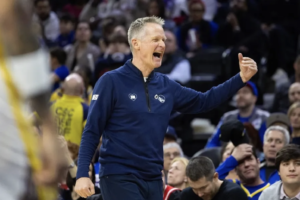
There’s no way the NBA is going to cut back on its number of games.
Going from 82 to 72 games, as Steve Kerr suggested this week, would create a 12% decrease in game-day revenue.
The billionaire owners – or shall we say, their ticket-buying fans – might be willing to absorb that, but no way the millionaire players go for it.
If only there were a way …
C’mon, you had to know I have a solution.
The key to solving this equation is understanding where the NBA’s money comes from. It’s the various television contracts.
The TV people have to be kept happy in any new arrangement.
They’re proud as peacocks now, so why change the presentation? The goal here is not to shorten the season, but rather to shrink the number of games.
As it stands now, the NBA campaign runs 173 days. Squeezing 82 games in there leaves just 91 days off. That’s 10 weeks with four games per team and 14 weeks with three.
And you thought the LA freeway was congested.
By cutting back to 72 games but keeping the 173-day schedule, you get exactly three games a week, with 10 additional days off, going from 91 to 101.
That sounds more reasonable from a players’ perspective … as long as they still get their money. Understood.
Here’s how that would work:
By keeping the schedule at 24 weeks, the big-money networks would still have the same number of telecast dates. No money lost. No reason to renegotiate any deals.
So, the TV people are happy and the players are happy. That just leaves the owners and those five home dates lost per team.
Alas, that’s not a problem, either.
First off, while nothing can be done about existing deals, owners would have the ability to cut back on future player contracts, right? The question is: How much?
That would depend upon a key transition the league is undergoing as early as next season.
The NBA has been snatching up local TV rights. This will soon become another major revenue source … one with no collective bargaining agreement that will guarantee the players anything.
So, while the owners might take a small hit short-term, they’ll be just fine, too.
But that’s not all. Greater breathing room in the schedule also creates the opportunity for a greater viewing product.
You’ve heard the complaints: We’re not watching because stars aren’t playing. And we don’t even know where to find the games in the first place.
Well, with no four-game weeks, there will be no need for back-to-backs. Take away back-to-backs and you greatly increase the possibility that your old men won’t need a night off.
Equally important is the difficulty in finding games. Spreading out the schedule could help fix that problem as well, as long as the league becomes a little more creative.
The NBA needs a “Basketball Night in America” – one game, marquee matchups, NBC, Shaq and the guys. It appears NBC wants that night to be Tuesday, so let’s keep it on Tuesday.
But let’s give everyone else the night off.
And with maximum potential exposure, let’s make it an attraction to more than just serious basketball fans.
Let’s create a 24-person Celebrity Shootout, to be contested at halftime of the game. Big names. REAL big names. Single-elimination, March Madness-style. One head-to-head per week.
I can already see Charles choreographing a “Gone Fishing” segment at the end of the night, complete with a live interview with the loser.
This could be your viewer-magnet Super Bowl halftime show. Only weekly.
Then let’s take our second-most important network, Peacock, and give them Sunday night. Again, just one game on the schedule. Others can play earlier in the day, but at 8 p.m. Eastern, all eyes are on two teams.
And I’d even give this game a side attraction – a Survivor Pool in which all Peacock subscribers are invited to pick the winner of the game. Afterward, we find out how many got it right, and thus earn the right to advance to pick again next week, and how many were eliminated.
Did I mention $1 million – it might have to be “paid” in Peacock gear to satisfy the various state gambling laws – to the eventual winner?
Just two big-splash showdowns each week would leave more glamorous matchups for the NBA to sell on its new local-television deal, which keeps the revenue streams flowing even while the players are getting more time off.
Everybody wins. Even the fans.
Imagine that.