
Most clubs do not lose families because of poor programs. They lose them because the value of those programs is not clearly documented, explained, or easy to verify. In today’s environment, visibility is not about promotion. It is about trust.
That trust is measured the same way by parents and by Google.
Why Google and Parents Are Evaluating Volleyball Clubs the Same Way
Google’s shift from E-A-T to E-E-A-T made one point clear: experience matters, and it must be demonstrated. The update reflects the rise of generic, AI-generated content that sounds credible but lacks real-world grounding.
Parents follow the same evaluation process when assessing a volleyball club, even if they do not describe it in technical terms. They are asking:
- Does this club operate organized, well-managed programs?
- Do the Coaches know how to teach and communicate effectively?
- Are expectations clear and consistent?
- Can I trust what I am seeing and reading?
Most clubs already have the answers. The problem is those answers live in conversations, emails, and group chats instead of being organized into durable, accessible content.
This is where content as proof becomes essential.
Content Is Evidence, Not Marketing
When Dennis Yu talks about content, he is not referring to posting more frequently or chasing engagement. He is referring to documenting reality in a structured way so trust becomes obvious.
For volleyball clubs, proof already exists in areas such as:
- How tryouts are evaluated and communicated
- How teams are formed and developed
- How Coaches correct athletes during practice
- How tournament weekends are managed
- How expectations are established with families
- How athletes progress throughout a season
When this information remains scattered, it does not compound. When it is documented once and positioned intentionally, it reduces confusion and scales trust.
To execute this effectively, clubs need structure. That structure is defined through the SEO Tree and the 6 Stage Content Factory.
The SEO Tree: Organizing Content The Way Decisions Are Made
The SEO Tree explains where content belongs and why structure matters.
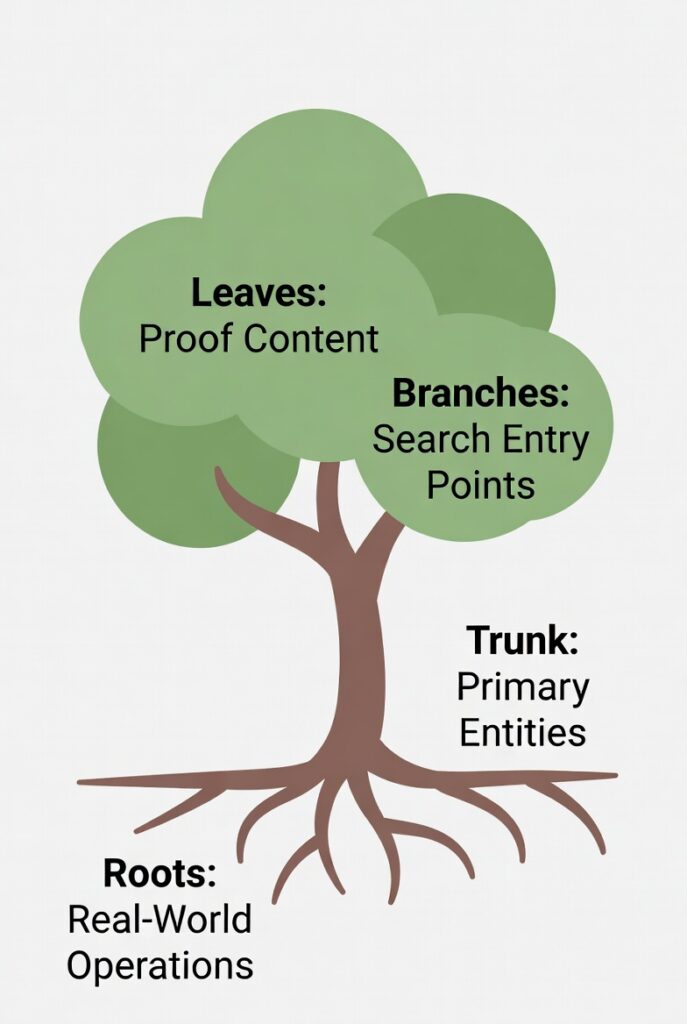
The roots of the tree are the club’s real-world operations. Coaching quality, athlete development systems, communication standards, safety protocols, scheduling discipline, and culture all exist here. No digital strategy can compensate for weak roots. Strong roots create leverage.
The trunk represents the club’s primary online entities, the platforms that define who the club is. This includes the main website, core program pages, and official profiles that serve as the source of truth.
From the trunk grow the branches, which align with how parents actually think and search. Clubs are not evaluated as abstract brands. They are evaluated through specific entry points, such as:
- Tryouts by age group
- Camps and clinics by season
- Boys’ and Girls’ Programs
- Private training or supplemental offerings
- Location-based programs, when applicable
The leaves are the proof content that supports those branches. These are not random social posts. They are intentional documentation connected to the pages where decisions are made.
Examples include:
- Short Coach explanations embedded on tryout pages
- Practice clips demonstrating how skills are taught
- Parent FAQs clearly answered and reused
- Tournament recaps that provide context, not just photos
- Athlete development stories documented over time
When content is structured this way, it stops floating and starts reinforcing trust.
E-E-A-T Applied to Volleyball Clubs
E-E-A-T becomes clear when viewed through operations, not marketing.
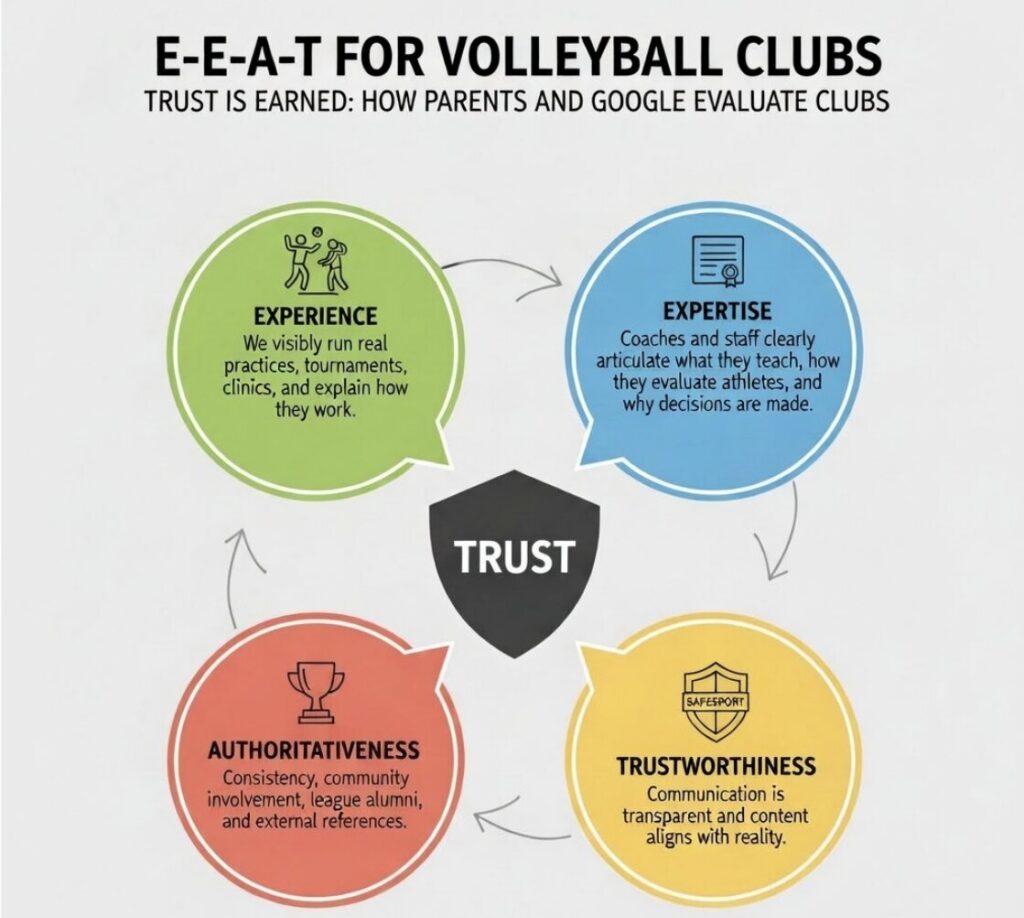
Experience is demonstrated when a club consistently runs organized practices, tournaments, clinics, and tryouts, and explains how those systems operate.
Expertise is evident when Coaches and staff clearly articulate what they teach, how they evaluate athletes, and why decisions are made.
Authoritativeness develops through consistency, community involvement, league participation, alumni outcomes, and credible external references.
Trust is established when communication is transparent and published content aligns with real-world operations.
None of this requires high production value. It requires clarity.
The 6 Stage Content Factory Reframed for Volleyball Clubs
The 6 Stage Content Factory is not a posting schedule. It is a sequential system designed to ensure content supports measurable outcomes instead of becoming another task for a Club Administrator.
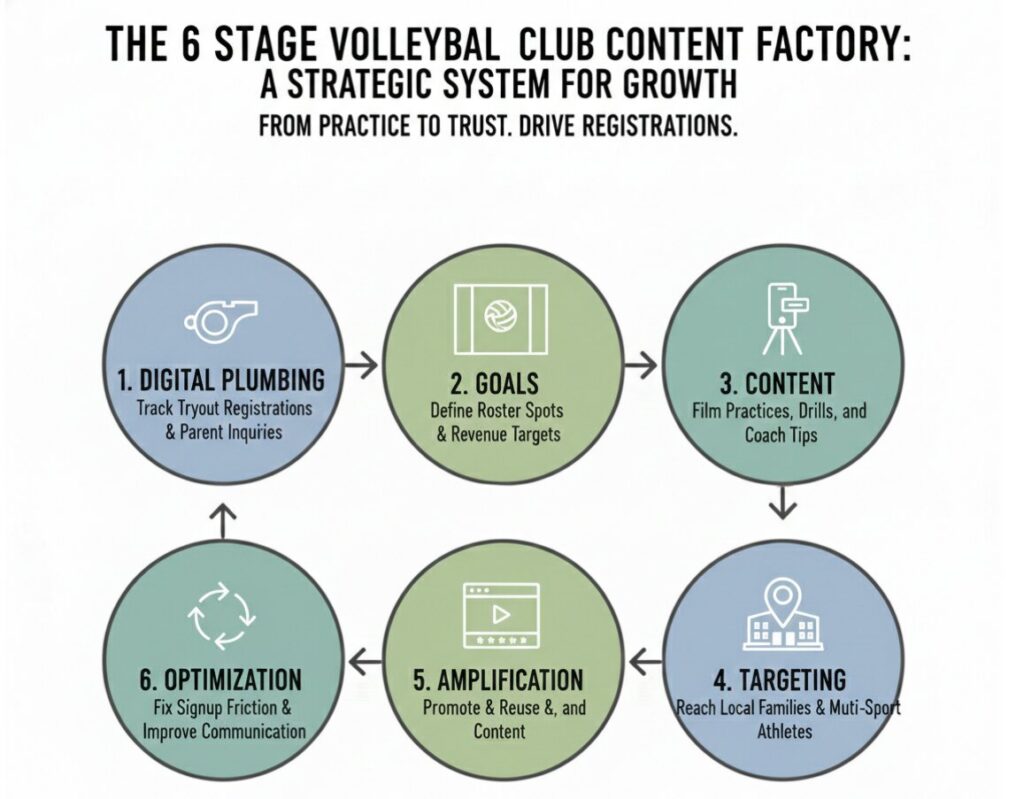
Stage 1: Digital Plumbing
Before creating additional content, clubs must measure what matters. Tryout registrations, camp signups, inquiries, and conversions should be tracked so decisions are based on data, not assumptions.
Stage 2: Clear Goals
Vague goals produce vague content. Defined targets, such as specific registration numbers within a set timeframe, give content direction and accountability.
Stage 3: Content, The Proof Layer
This stage focuses on documenting what parents and athletes need to understand before committing. Much of this information already exists in conversations. Capturing it once reduces friction across every touchpoint.
Stage 4: Targeting
Strong proof loses impact if it reaches the wrong audience. Targeting ensures families evaluating club volleyball see the explanations and evidence directly tied to their decision.
Stage 5: Amplification
Instead of constantly creating new material, clubs identify which explanations resonate most. Over time, this builds a library of proven content that can be deployed strategically during key registration periods.
Stage 6: Optimization
Optimization strengthens what already works. Pages are clarified, proof is positioned closer to decision points, and common questions are addressed proactively. This converts seasonal efforts into repeatable systems.
Why This Approach Compounds Over Time
Dennis Yu often describes Google as a lie detector. Attempts to manipulate systems eventually fail because they lack alignment with reality. Clubs that document their actual operations, explain them clearly, and organize them intentionally create signals that compound over time.
Each season adds proof. Each group of athletes adds context. Each clarification reduces future confusion. Visibility becomes the byproduct of operational competence, not a separate marketing effort.
Continue the Conversation at Align Volleyball Summit
Dennis Yu and Dylan Haugen will return to the Align Volleyball Summit to provide a deeper application of the 6 Stage Content Factory, the SEO Tree, and E-E-A-T for volleyball clubs. They will also address how AI can be used responsibly to process real proof without replacing authenticity.
Learn more and register for Align.