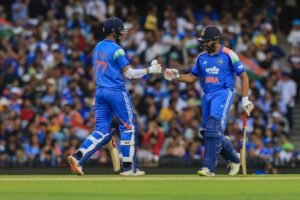

Team India opener Rohit Sharma registered another failure with the willow in the second ODI against England at Sophia Gardens in Cardiff on Thursday, July 16. After the Men in Blue were sent into bat, the Hitman was dismissed for 26 off 47 balls, a slow knock which only featured one four and a six.
Rohit was dropped in the third over of the innings by Gus Atkinson off Jofra Archer’s bowling. However, he could not capitalize on the opportunity and was dismissed by Will Jacks in the 18th over as he top-edged an attempted sweep. The 39-year-old also struggled in the first ODI in Birmingham and was eventually dismissed by 11 off 21 balls.
As per some media reports, Team India are unlikely to continue with Rohit after the third and final ODI against England at Lord’s on Sunday. On that note, let’s take a look at three batters who can potentially replace Rohit as Shubman Gill‘s opening partner in ODIs in the build-up to next year’s World Cup.
#1 Yashasvi Jaiswal
Yashasvi Jaiswal is the leading contender to replace Rohit as Gill’s opening partner in the one-day side. The 24-year-old has been waiting in the wings for a while now. In six one-day matches so far, the southpaw has scored 285 runs at an average of 71.25 and a strike rate of 97.60.
Jaiswal has already notched up two centuries in his one-day career. He hammered an unbeaten 116 off 121 balls against South Africa in Visakhapatnam in December 2025. The sublime knock featured 12 fours and two sixes. He also slammed 110* off 86 balls against Afghanistan in Chennai in June 2026, with the aid of 14 fours and three sixes.
Jaiswal has been around the Indian team for a few years now and has delivered impressive performances in all three formats. With the ODI World Cup still more than a year away, this is the right time to bring in Jaiswal as Gill’s opening partner in the one-day format.
#2 Ruturaj Gaikwad
Chennai Super Kings (CSK) skipper Ruturaj Gaikwad is another batter Team India can try out as Gill’s opening partner in the one-day format. The 29-year-old had a rather underwhelming IPL 2026 campaign, scoring 337 runs at an average of 28.08 and a strike rate of 123.44. However, there is little doubt when it comes to the kind of batting talent that he possesses.
In a stop-start international career, Gaikwad has played nine one-day matches for Team India. In eight innings, he has scored 228 runs at an average of 28.50 and a strike rate of 89.76, with one hundred and one half-century to his name. Gaikwad scored 105 off 83 against South Africa in Raipur in December 2025. He also struck 71 off 77 against Australia in Mohali in September 2023.
Gaikwad may not be a front-runner to replace Rohit as Gill’s opening partner in the one-day side. However, if given an opportunity, the talented right-handed batter will be confident of coming up with the goods.
#3 Sanju Samson
Just in case Jaiswal is unable to cement his place in the one-day side as Rohit’s replacement, Sanju Samson could be the dark horse to clinch the spot. The 31-year-old Kerala stumper has featured in only 16 one-day matches, but has an impressive record in the format. In 14 innings, he has scored 510 runs at an average of 56.66 and a strike rate of 99.60, with one ton and three fifties.
Samson’s last ODI match for India was against South Africa in Paarl back in December 2023. Incredibly, the right-handed batter scored a hundred in this match, smashing 108 off 114 balls, with the aid of six fours and three sixes. He also scored 86* off 63 against South Africa in Lucknow in October 2022. The knock featured nine fours and three sixes.
Although consistency has been an issue with Samson right through his international career, the keeper-batter proved in the T20 World Cup earlier this year that he can deliver the desired results under immense pressure. This is one quality the BCCI selectors must definitely keep in mind when they zero in on Rohit’s replacement in the ODI squad, with an eye on the 2027 World Cup.
Edited by Renin Wilben Albert