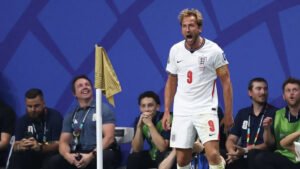
For the first time in a very long time, England have a World Cup star in Harry Kane who enjoys embracing the moment.
And sometimes, the World’s biggest sporting event is as simple as that.
Kane’s second-half brace to lead the Three Lions back from the brink of early elimination shouldn’t ease all the skepticism surrounding Thomas Tuchel’s squad.
This was a team that was significantly troubled by DR Congo during 90 minutes of climate-controlled football in Atlanta. The test will get much more acute in the next round at altitude against Mexico on Sunday night, a turnaround that provides too little time to truly acclimatize.
But in the modern mega event the World Cup has become, Kane’s comfort in the spotlight is irreplaceable and unlike nearly every other Great English hope before him.
Afterward, he even implored his team to follow his example.
“I think it’s easy when you’re one of the bigger nations to just let these moments slip by,” Kane said postmatch. “And no matter who you are, you have to enjoy going through in knockout football. So enjoy this moment.”
Curiously, the game’s inventors haven’t produced more attackers of Kane’s international prolificness.
Kane’s fourth and fifth goals of this tournament put him even with Brazilian legend Pele at 13 for his career. But they also put him three clear of Gary Lineker, England’s second all-time leading World Cup scorer, and eight above Geoff Hurst, the next-highest Three Lions striker and 1966 World Cup winner.
Germany have 11 players who have scored at least six World Cup goals. Brazil have 10. Argentina have five. Even famously defensive (and currently absent) Italy have four.
And for all those who want to wax poetic about tactics and systems, the game is often as simple as having players who can find the net when it matters. So what makes Lineker and Kane different? It might be their willingness to embrace environments outside the pinnacle of the English game.
Both Lineker and Kane played club football at teams outside England’s established perennial winners during their domestic careers. (Lineker eventually had a brief spell at Everton, who are nine-time league champions but also the second-most decorated club in Liverpool.) When they finally moved to blue bloods, they did so beyond their national borders, Lineker at FC Barcelona and Kane to Bayern Munich.
That willingness to embrace outsider environments has to make the atmosphere of a World Cup — in which the surroundings of the stadiums, the officials and the opponents are unfamiliar — easier to deal with. Because it’s a skill you’ve acquired. The problem is that leaving England means leaving arguably the best club league in the world. But this particular squad appears to get the advantage, at least relative to Three Lions squads of the past. Kane is one of four players who ply their club trade abroad, which, believe it or not, is an England World Cup record.
Lineker and Kane also possessed unusual openness to a media corps whose rift with its national team can be particularly fractious.
Lineker went on to be a long-time TV presenter after his playing career. The equally affable Kane could have a lengthy future there also, on the other side of the mixed zone velvet ropes.
The Three Lions won’t win the World Cup at a press conference. But embracing the spotlight sure as hell doesn’t hurt. Kane’s leadership makes this a group more resolved to at least try that, even if it doesn’t come naturally to all.
If they go on to end the world’s most famous 60-year title drought, don’t discount the role that will play.