
Every coach knows the frustration: you tell an athlete the same thing over and over, and they keep making the same mistake. It’s easy to assume the player isn’t listening. But most of the time the problem isn’t the athlete at all — it’s the kind of feedback we’re giving, and when we’re giving it.
There is one mistake in particular that even experienced, well-meaning coaches make without realizing it: they load athletes up with internal feedback at the exact moments those athletes need to be automatic. Understanding why that backfires — and what to do instead — is one of the highest-leverage things you can learn as a coach.
Internal feedback directs an athlete’s attention to what their own body is doing — hand position, footwork, muscle activation, joint angles. It is useful when someone is first learning a skill, but for more advanced athletes it often makes performance worse.
External feedback directs attention to the effect the athlete wants to create out in the world — the ball, the target, the space. Instead of telling a player to fully extend their arms (internal), you tell them to reach their arms toward the ceiling (external). Same movement, completely different result, because the athlete stops micromanaging their body and lets it work.
This isn’t a coaching opinion — it’s one of the most replicated findings in motor learning. Dr. Gabriele Wulf has spent years studying attentional focus, and her research is consistent: an external focus makes movement more automatic, while an internal focus disrupts it. She calls the mechanism the constrained action hypothesis — when you consciously control a movement, you actually interfere with the automatic systems that normally run it beautifully on their own.
“External focus affects motor learning by directing attention to the outcomes of movements instead of the movements themselves. The goal is to make actions more automatic and reduce conscious control.” — Dr. Gabriele Wulf
A classic golf study showed it plainly: novice golfers told to focus on “pushing against the ground” (external) outperformed those told to “shift their weight to the forward foot” (internal) on carry distance and accuracy. Same swing, different attention, better outcome.
To know when to use each type of feedback, you have to know where your athlete is in the learning process. Every skill a player develops moves through four stages:
The Four Stages of Learning
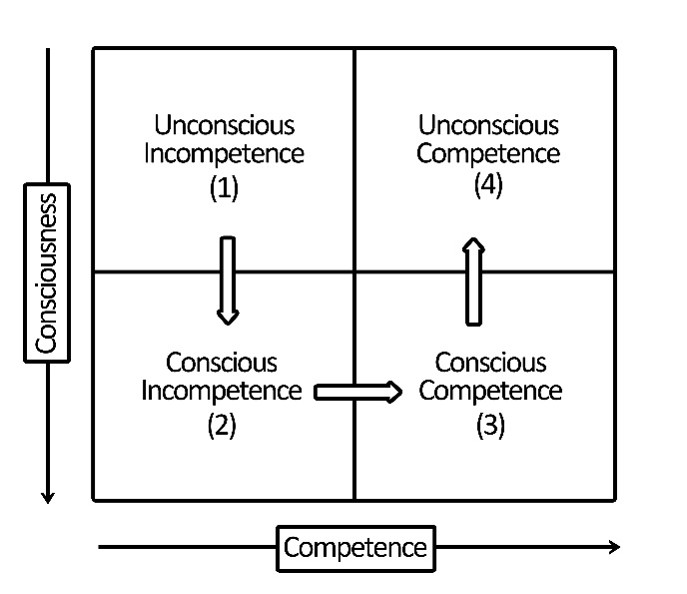
- Stage 1 — Unconscious Incompetence: the player doesn’t yet know what they don’t know.
- Stage 2 — Conscious Incompetence: the player now knows the skill exists and knows they can’t do it well yet.
- Stage 3 — Conscious Competence: the player can perform the skill, but only by thinking about it and concentrating.
- Stage 4 — Unconscious Competence: the skill is automatic. The player just does it, freeing their mind to read the game.
Here’s how feedback maps onto these stages. In Stages 1, 2, and 3, internal cues can genuinely help — players often understand a movement pattern more easily at first when they can relate it to their own body. Our goal in those early stages is for the player to understand the skill and perform it consciously. But once a skill reaches Stage 4, external feedback is always better. Reaching in with internal, technical cues at Stage 4 drags a skilled athlete backward into conscious control — the very thing that breaks automatic movement.
This is the insight that changes everything. Getting a player through Stages 1, 2, and 3 — building clean, repeatable technique — is essential, but it’s only about 40% of what makes a great volleyball player.
Technique (Stages 1–3) is roughly 40% of the game. The other 60% is Stage 4: reading the game, slowing the game down, and eliminating pressure.
The other 60% lives entirely in Stage 4, and it is what separates good players from great ones: reading the game, slowing the game down, and eliminating pressure. You cannot do any of those things while you’re thinking about your platform angle or your footwork. They only happen when technique has become automatic and the mind is free to anticipate, decide, and react. That is why an external focus matters so much — it keeps players in the automatic, game-reading state where the majority of the game is actually won.
“Read the game, slow the game, and eliminate pressure!” — Andor Gyulai
The mistake coaches don’t realize they’re making, then, isn’t just using internal cues — it’s spending nearly all their energy on the 40% (technique) and almost none on the 60% (Stage 4 reading and decision-making), while using the wrong kind of feedback to get there.
This is exactly where our programs are built to be better. Most training stops at Stage 3 — it drills technique and hopes reading the game shows up on its own. We do two things differently.
First, we move players through Stages 1–3 faster, using the right blend of internal cues to build understanding early and external cues to make skills automatic quickly — with consistent coaching language across every level so players aren’t relearning the game each season.
Second — and this is the difference — we actually teach Stage 4. We don’t leave the 60% to chance. We train reading the game, slowing the game down, and playing under pressure directly and deliberately, using frameworks like the OODA Loop (Observe, Orient, Decide, Act) along with other methods that are unique to how we coach.
The OODA Loop, originally developed for fighter pilots making split-second decisions, describes exactly what elite volleyball players do on every rally: they observe the play developing, orient to what it means, decide, and act — faster than their opponent. When you train that loop on purpose, players start to “slow the game down” because they’re processing it a step ahead. That is Stage 4, and it’s teachable. Most programs never even try.
At Volleyball1on1 and SJVC, we pair fast, smart technical development with deliberate Stage 4 training. Advancing players quickly through the 40% so we can spend real time on the 60% is why our athletes read the game, stay calm under pressure, and keep improving long after technique-only training would have plateaued.
You can start putting this to work in your next practice with a simple shift: cue the outcome, not the body part.
- Passing: instead of analyzing platform position, have players focus on what they see — the ball’s height and the target they’re passing to.
- Blocking: instead of “press your hands over the net,” tell blockers to reach their palms toward the back wall.
- Setting: instead of “extend your arms fully,” cue them to finish reaching toward the ceiling.
- Early learning (Stages 1–3): it’s fine — often better — to use internal cues to help a brand-new skill make sense. Just transition to external cues as the skill becomes automatic.
Match the feedback to the stage, keep advanced athletes external, and don’t stop at technique. Spend real time teaching your players to read the game, slow it down, and eliminate pressure — because that’s where 60% of volleyball is actually played.
Want to train the full picture — technique and Stage 4 game reading? Learn more about our camps, club, and coaching at Volleyball1on1.com.