
Last year, we wrote that outdoor volleyball was thriving, not just surviving. The 2026 data reinforces that conclusion.
Across Volleyball Life, participation continues to grow, returning organizers are reaching more athletes, and the sport’s largest destination events continue to attract significant demand.
At the same time, the market is becoming more mature. Growth is not happening in exactly the same way across every segment. Adult grass is expanding rapidly, junior beach is entering a more established phase, and major destination events continue to strengthen their place in the outdoor volleyball ecosystem.
The overall picture remains positive: more athletes are playing, established organizers are growing, and the outdoor volleyball market continues to become larger and more sophisticated.
More Athletes Are Playing Outdoor Volleyball
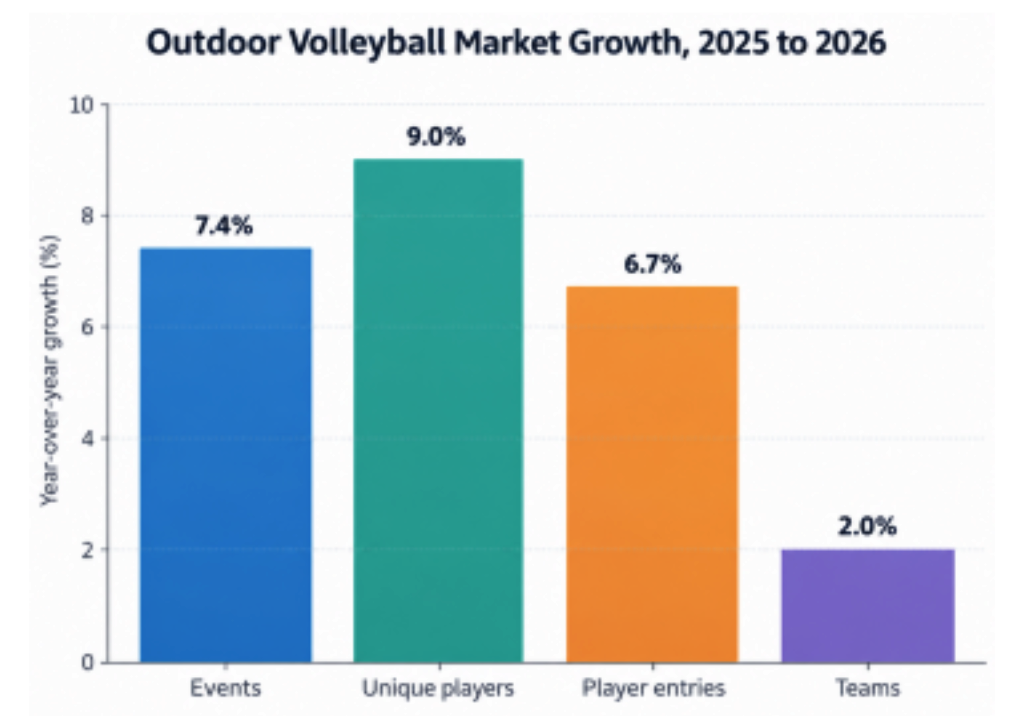
From January 1 through September 10, overall Volleyball Life activity increased again in 2026:
- 4,708 events, up 7.4% from 4,385
- 124,817 unique players, up 9.0% from 114,543
- 322,760 player entries, up 6.7% from 302,605
- 135,305 teams, up 2.0% from 132,603
The most encouraging number may be unique participation.
Nearly 125,000 athletes competed in an outdoor volleyball event on Volleyball Life during the first eight-plus months of 2026.
Some of that growth reflects additional organizers moving onto Volleyball Life, but the growth is not simply a result of adding more events or more clients.
Among returning outdoor organizers, the number of events was essentially flat year over year, increasing just 0.2%.
Participation still grew.
Within that returning-organizer group:
- Unique players increased approximately 7%
- Player entries increased approximately 5%
- Teams increased approximately 1.5%
In other words, existing organizers were reaching more athletes and generating more participation without materially increasing the number of events on the calendar.
That gives us greater confidence that the growth we are seeing is not just platform expansion. There is real growth happening within the existing outdoor volleyball ecosystem.
Adult Grass Continues to Accelerate
Adult grass volleyball was the clearest growth story in 2026.
Among the same returning organizers, adult grass saw substantial year-over-year increases in players, teams, entries and events.
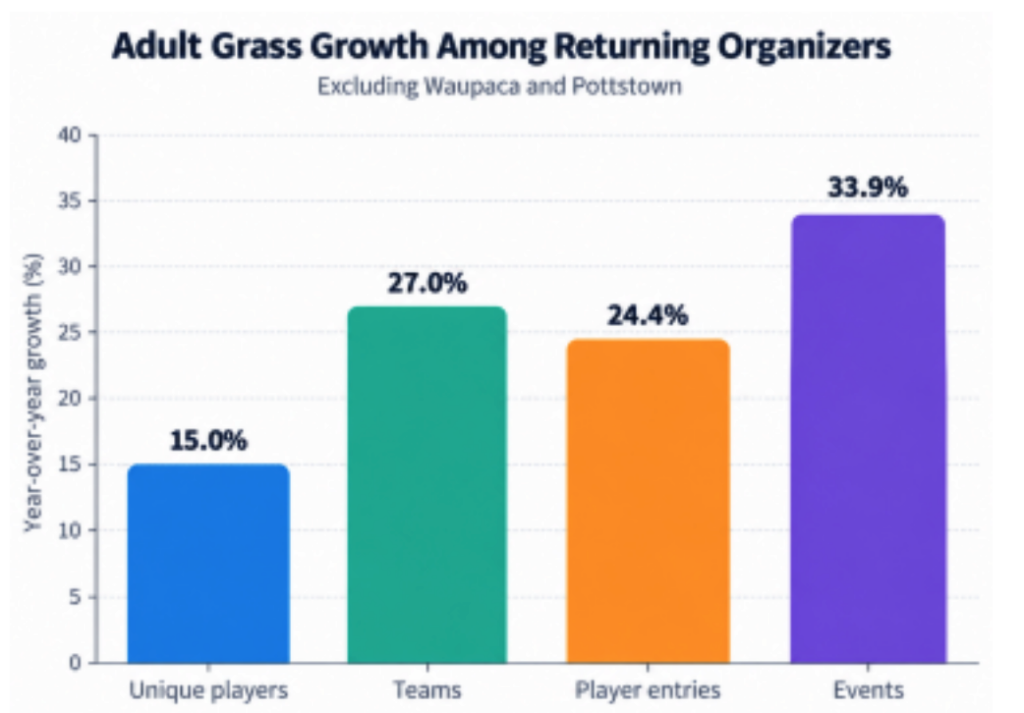
To make sure that growth was not simply being driven by a small number of major tournaments, we removed Waupaca Boatride and The Pottstown Rumble from the analysis.
The result barely changed.
Among returning adult grass organizers excluding Waupaca and Pottstown:
- Unique players increased 15%
- Teams increased 27%
- Player entries increased 24.4%
- Events increased 33.9%
That is broad-based growth.
Established organizers are expanding, newer operators are gaining traction, and players are increasingly participating across multiple organizers rather than remaining inside a single local ecosystem.
The average adult grass participant is also playing more frequently than a year ago. The takeaway is straightforward: grass volleyball has significant momentum.
Junior Beach Is Entering a More Mature Phase
Junior beach tells a different story.
Overall junior beach team and entry totals were softer in 2026, but deeper analysis suggests the shift was driven more by fewer new athletes entering the market than by changes in participation among established players.
Among junior beach participants:
- The number of first-time players declined from 18,307 in 2025 to 17,050 in 2026 ● The number of players with prior junior beach experience increased from 13,551 to 14,315
- Player participation frequency remained remarkably consistent year over year
In 2025, 51.5% of junior beach players competed in exactly one event. In 2026, that number was 51.9%.
The percentage playing four or more events was also essentially unchanged.
At the same time, the number of junior beach events on the calendar declined. There were fewer events per active week in 2026 and a lower peak weekly event count than in 2025.
Taken together, the data suggests a market that is normalizing after years of rapid expansion, while engagement among established participants remains remarkably consistent.
The established participant base remains healthy.
The next major opportunity may be less about simply adding more tournaments and more about introducing new athletes to beach volleyball and creating experiences that bring first-time participants back for a second, third and fourth event.
Junior National Championships Remain Strong
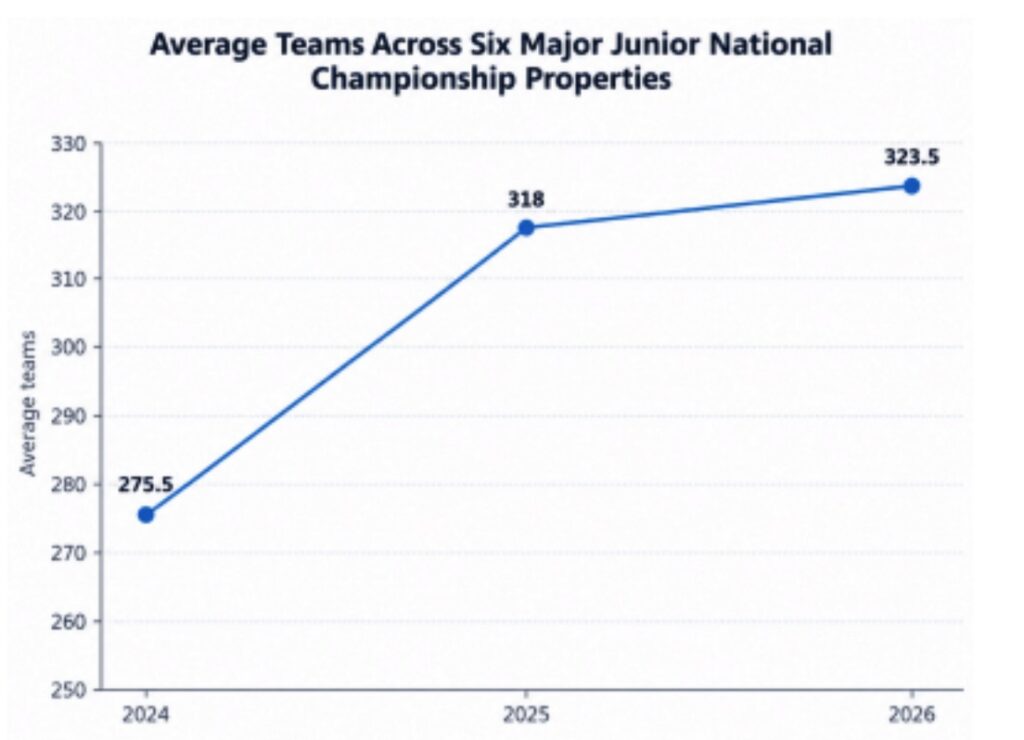
Last year, we examined six of the largest junior beach national championship properties and found that their average field size had grown from 275.5 teams in 2024 to 318 teams in 2025.
That trend continued in 2026.
Across the same championship properties, average field size reached approximately 324 teams.
That represents:
- 17% growth since 2024
- Another modest increase from 2025
Not every championship grew in exactly the same way.
Some organizations changed formats, including moving from one national championship to multiple regional championship events. But taken together, the major championship ecosystem remains extremely healthy.
Athletes and families are continuing to travel for meaningful, high-level junior beach competition.
Destination Events Continue to Get Bigger
Some of the strongest evidence of continued demand comes from the sport’s major destination events.
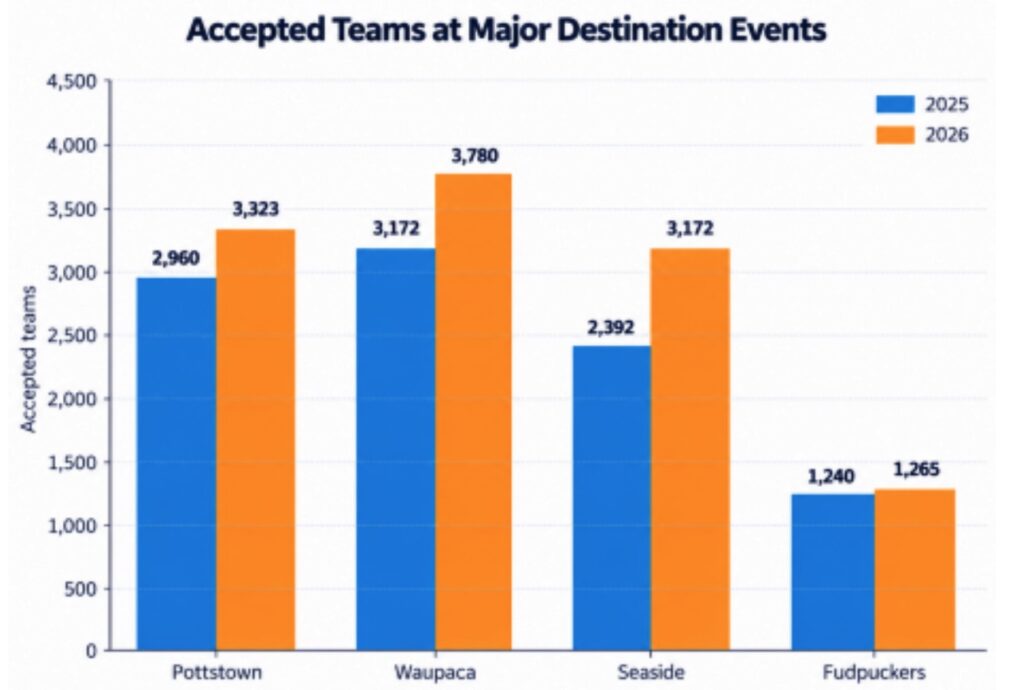
Accepted team participation increased again at four of the largest outdoor volleyball events in the country:
- Seaside: 2,392 accepted teams in 2025 to 3,172 in 2026, up approximately 33% ● Waupaca: 3,172 to 3,780, up approximately 19%
- Pottstown: 2,960 to 3,323, up approximately 12%
- Fudpuckers: 1,240 to 1,265, up approximately 2%
Across the four events, accepted team participation increased by more than 18% year over year.
But total size only tells part of the story.
The speed at which athletes register may be even more revealing.
Across the four destination events, nearly 6,500 registrations came in during the first week of registration activity.
These are not simply volleyball tournaments anymore.
They are destination experiences that athletes plan around months in advance.
Across Pottstown, Waupaca, Seaside and Fudpuckers, nearly 2,850 teams encountered a waitlist during 2026 registration, another indication of the strong demand surrounding major destination events.
Bigger Is Not the Only Way to Grow
The success of the largest events does not mean every outdoor volleyball event needs thousands of teams.
In fact, one of the most interesting characteristics of the current market is its diversity. Some players want a major destination tournament.
Others want a competitive local event on a Saturday morning.
Some want doubles. Others want triples, quads or coed formats.
Some are chasing rankings or national championships. Others simply want more opportunities to play.
As the market grows, successful organizers are increasingly serving different types of volleyball consumers rather than trying to build the same event everywhere.
That creates opportunity throughout the ecosystem.
The Next Opportunity Is Better Experiences
The 2026 market suggests that the next stage of outdoor volleyball growth will not come exclusively from adding more events.
It will come from creating better ones.
That means:
- Easier registration
- Better communication
- Competitive and accurate divisions
- Reliable scheduling
- Quality facilities
- Memorable event environments
- Opportunities for players to return throughout the season
- Strong connections between local events, destination tournaments and championship experiences
Outdoor volleyball has already demonstrated that athletes want to play.
The next challenge is giving them more reasons to keep coming back.
The Bottom Line
Outdoor volleyball remains healthy and continues to expand.
Nearly 125,000 unique athletes participated through Volleyball Life during the first eight-plus months of 2026.
Importantly, that growth is not simply coming from more events being added to the platform. Returning organizers ran essentially the same number of events while reaching approximately 7% more unique players.
Adult grass is experiencing significant growth.
The largest junior beach championships remain strong.
Major destination events continue to expand and, in many cases, generate more demand than they can immediately accommodate.
Junior beach is entering a more mature stage, with a large established participant base and a clear opportunity to bring more new athletes into the sport.
The market is no longer simply proving that outdoor volleyball can grow.
It is beginning to show what a larger, more sophisticated outdoor volleyball ecosystem can look like.
View more on beach volleyball and running a beach tournament.
About the Author
Kevin McColloch is also the COO of Volleyball Life, an event scheduling and results platform for outdoor volleyball events. Kevin is a former AVP Professional Athlete from 2002-2016 and the former UC Davis Assistant Beach Volleyball Coach from 2018-2021.